GPT-6 Astra Falls 100x Short on Speed and Cost for Real-World Robots, Nvidia Admits
 DM
 Newsroom
How did the Nvidia CEO replacement and Singapore chip export control investigation impact Nvidia's stock price?
What limitations did OpenAI's GPT-6 Astra show in real-world AI robotics applications?
What do Nvidia's technological innovation and regulatory risks mean for investors?
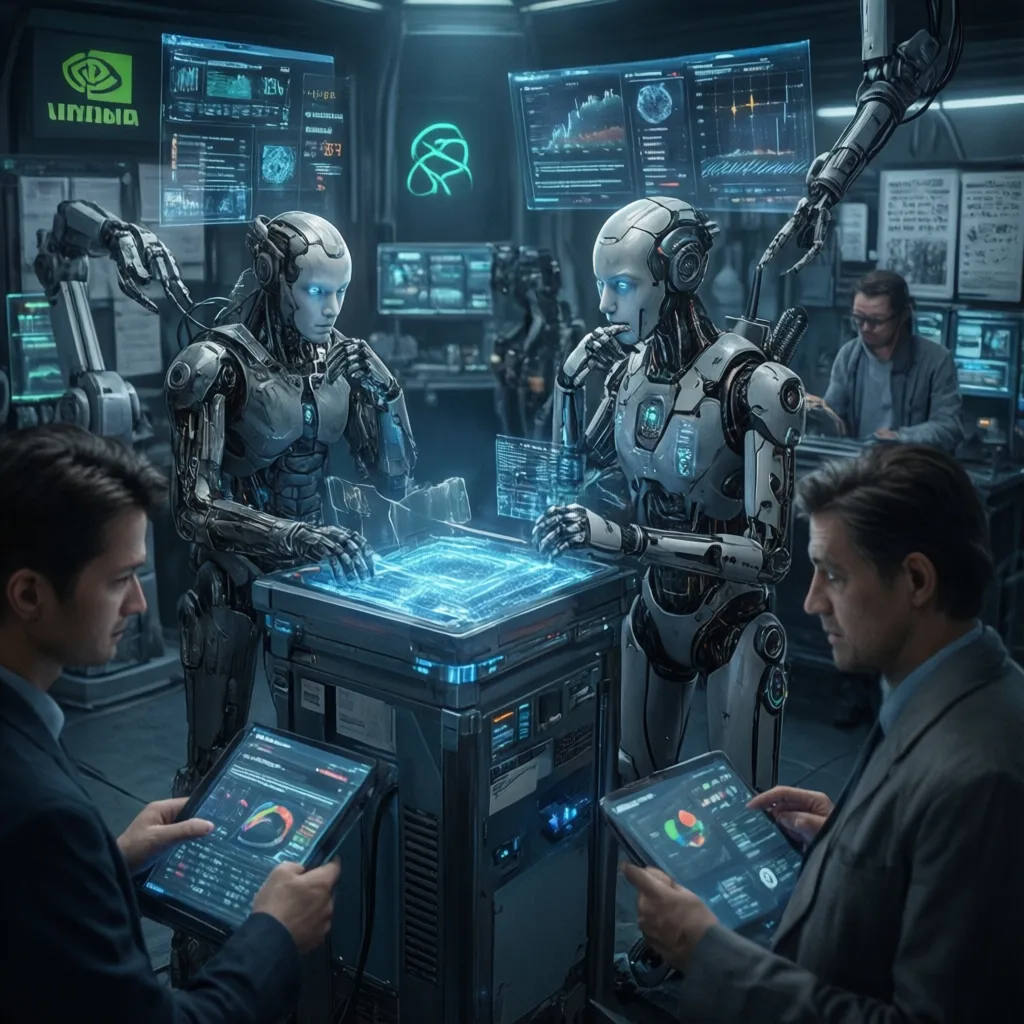
- Nvidia publicly praised GPT-6 Astra’s planning skills for robotics, but independent tests expose major speed and cost gaps.
- Studies confirm Astra is up to 100 times slower than humans and vastly more expensive, limiting real-world use.
On November 17, 2026 (UTC), TechTimes reported that Nvidia’s robotics chief Deepu Talla publicly endorsed OpenAI’s GPT-6 Astra model, calling it “a win for robotics” due to its advanced language-based planning capabilities. Talla pointed to Astra’s strong showing on simulated manipulation tasks, stating it outperformed specialized robot models and signaled a breakthrough for robotics technology.
The same day, TechTimes detailed Nvidia’s “Astranomy” study, presented at CoRL 2026. Astra achieved a 74.8% success rate on RoboLab-120 simulated tasks, edging out rival robot models. However, each decision from Astra took between 11 and 19 seconds, and the cost per episode hit $36.40—metrics that make it infeasible for real-time or production deployment.
Further independent evaluations added context to Astra’s real-world readiness. Artificial Analysis, using the AA-Robotics v0.1 benchmark on November 17, found Astra and similar language models to be about 100 times slower than humans, with average completion times of 30 minutes per task versus 20 seconds for human performance. Astra’s cost per task was $16.36. While Astra posted a 95% success rate on simple block-in-bowl tests, its accuracy plummeted to 10% in high-precision, millimeter-level tasks, matching the results seen in Claude Fable 5.1.
Comparisons with open-source alternatives highlighted Astra’s economic drawbacks. The Decoder reported on November 16 that Nvidia’s open-source Flora model could label robot videos for only $0.72 per hour, compared to $88.50 for Astra, as confirmed by Shattered.io on October 25. Flora’s 125-fold cost savings also came with better-quality annotations in head-to-head trials.
BigGo Finance, on November 7, noted that Astra’s robotic skills reflected its focused training data rather than generalizable intelligence. The model’s performance was mostly tied to one robot type, indicating likely overfitting.
Experts interviewed by TechTimes and The Decoder concluded that GPT-6 Astra works best as a slow, high-level planner. They stressed that current cloud-hosted language models like Astra remain unsuitable for replacing dedicated, real-time robotic controllers. The main blockers are slow inference, high operating expenses, and failure to achieve precise physical control.
These technical setbacks surfaced as Nvidia underwent CEO transition and faced a US regulatory investigation regarding export controls involving Singapore-based Megaspeed. In a joint statement on November 17, the Department of Commerce and Justice clarified Nvidia was not accused of any wrongdoing in the Megaspeed case. The statement addressed regulatory timelines and recent technology stock volatility.
Nvidia continues to promote GPT-6 Astra’s potential in robotics and maintains its partnership with OpenAI. Yet internal and independent results consistently show that Astra’s high latency, prohibitive costs, and lack of granular control make it impractical for real-world robot deployment today. Sector experts project that it will take at least two years to resolve these fundamental hurdles.

Get real-time crypto breaking news on Unblock Media Telegram! (Click)